

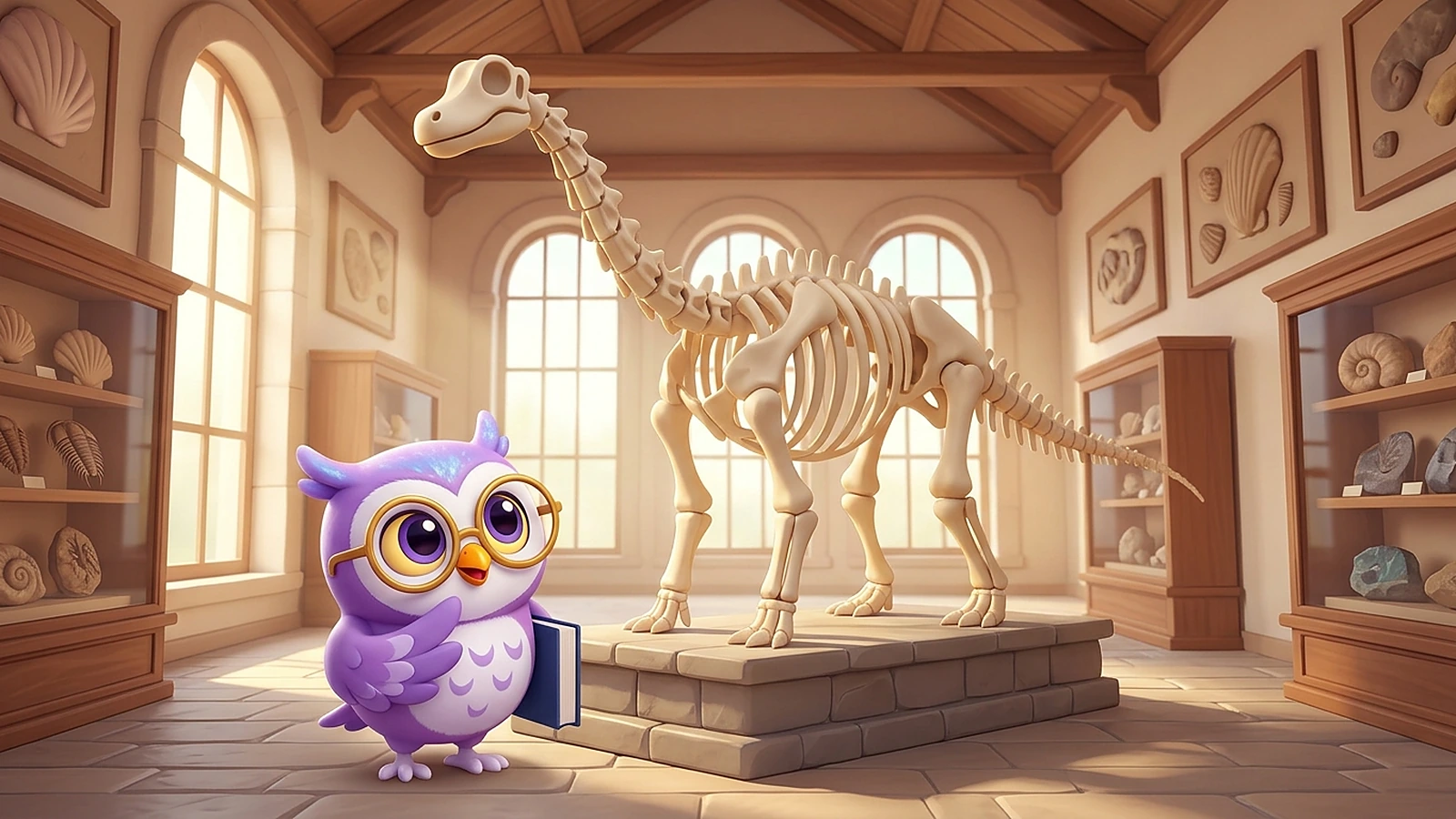
Topic world · ages 5–10
Dinosaurs
The giant dinosaurs lived millions of years ago, and no person ever saw one. So how do we know about them? Learn to read fossils, find out how dinosaurs lived and meet their descendants that still fly around us. Then go on a dig and try the 10-question quiz.
Cards
How do we know?
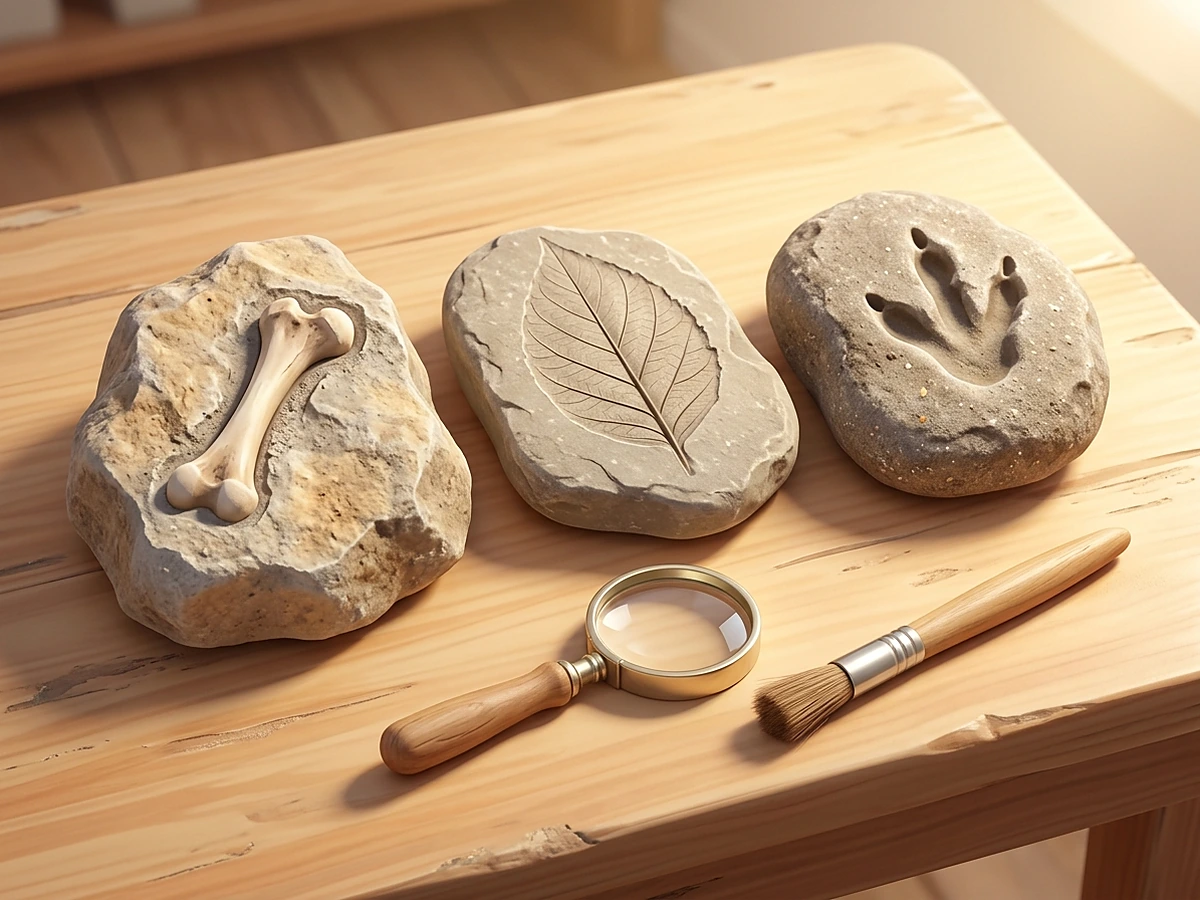
A fossil is a piece or trace of ancient life kept in rock
A fossil is what is left in rock of something that lived long ago. Bones, teeth, eggshells, footprints and even feather prints can become fossils.
Why? The soft parts of a body rot quickly. Hard parts like bones and teeth last long enough to turn to stone. That is why most dinosaur fossils are bones and teeth.
Try at home: Press a shell or a leaf into play dough, then lift it off. The print it leaves is like a fossil print.
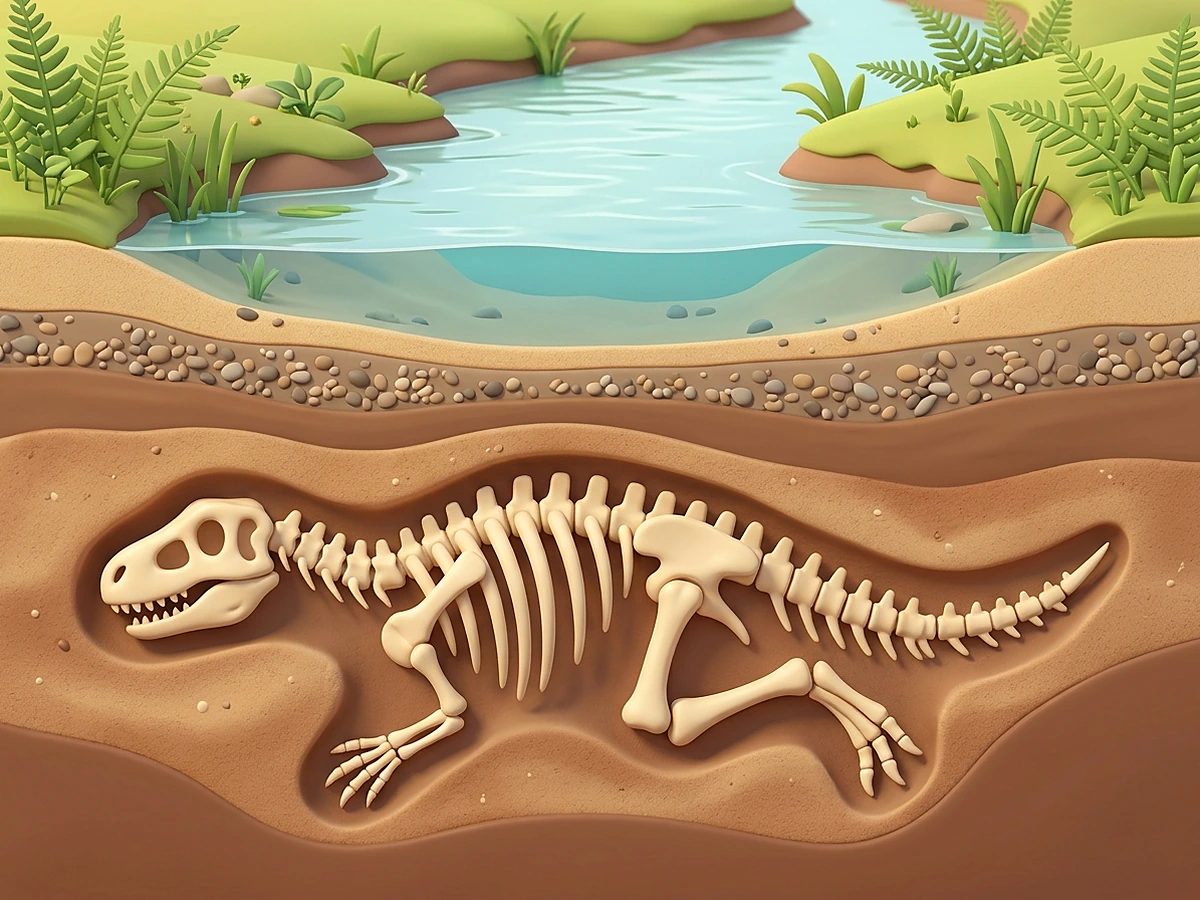
A fossil takes a very long time to form
If mud or sand covers an animal soon after it dies, it may become a fossil. Over thousands or even millions of years, minerals from water in the ground slowly fill the tiny holes in the bone. The bone becomes as hard as stone.
Why? When a bone is covered quickly, other animals cannot eat it, and wind and water cannot scatter it. Even so, only a very few living things ever become fossils.
Try at home: Put a little sand, water and a small pebble in a plastic jar. Close it tight, shake it and wait. Watch the sand slowly cover the pebble.
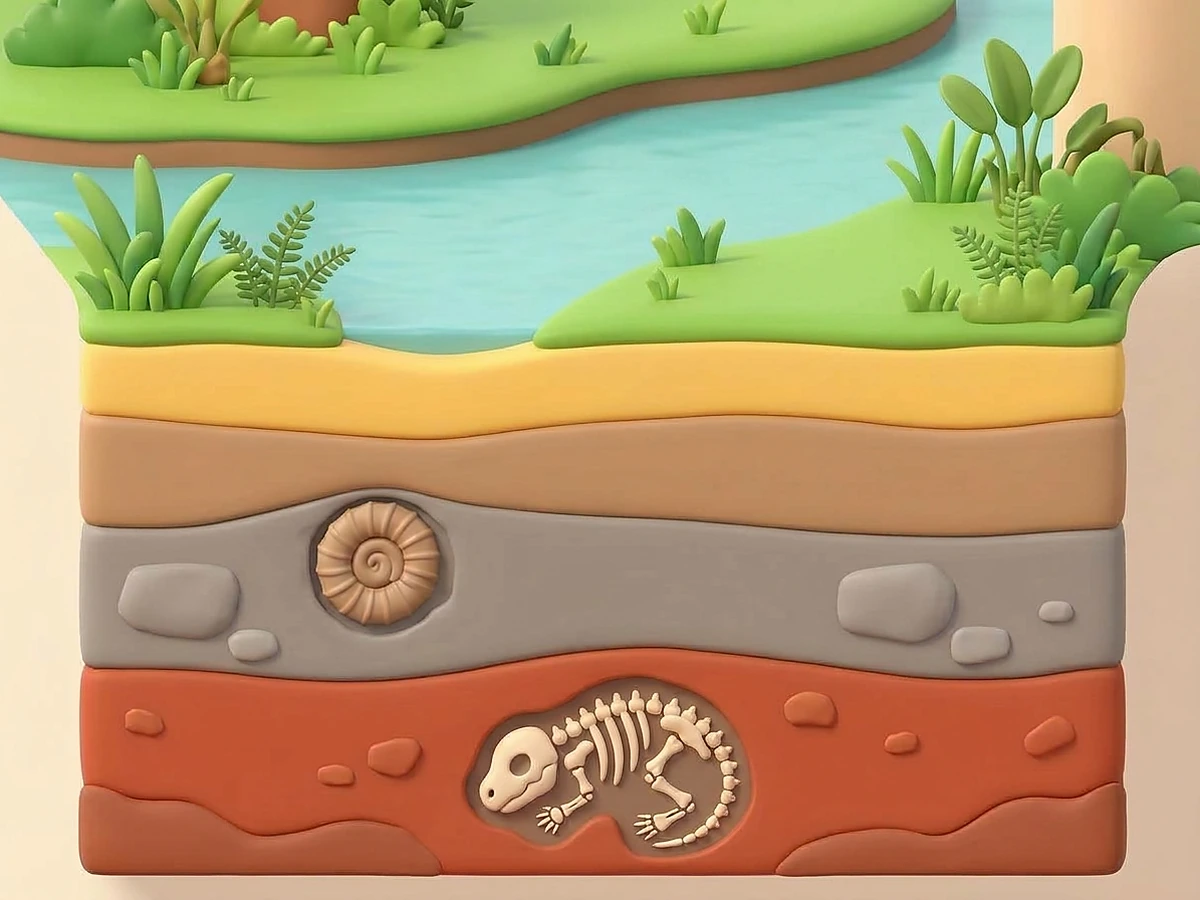
Rock layers are like the pages of a book
Sand and mud pile up layer by layer and slowly turn to rock. Each new layer settles on top of the older one. So the lower a layer is, the older it is.
Why? Dinosaur bones are found in layers much older than any with human bones. That is how scientists know that people never saw the giant dinosaurs.
Try at home: Stack three towels of different colours. Which one did you put down first, the one at the bottom or the one at the top?
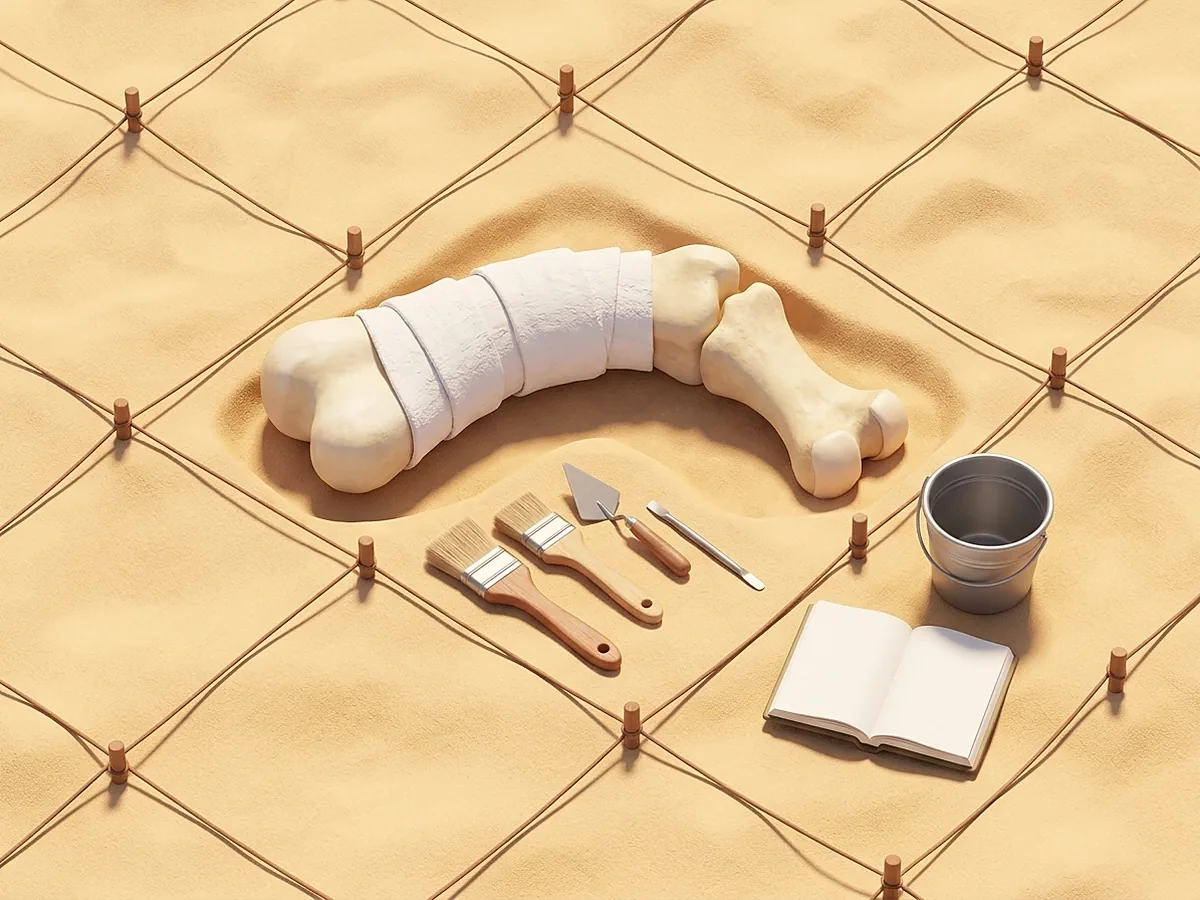
A palaeontologist digs slowly
A scientist who studies fossils is called a palaeontologist. At a dig, palaeontologists work with small tools and brushes. They wrap big bones in cloth and plaster before carrying them.
Why? Fossils break easily. And where each bone lies tells part of the story too. So palaeontologists take their time and write everything down.
Try at home: Pour sand into a tray and bury some small toys in it. Then uncover them slowly with a paintbrush.
Dinosaur life
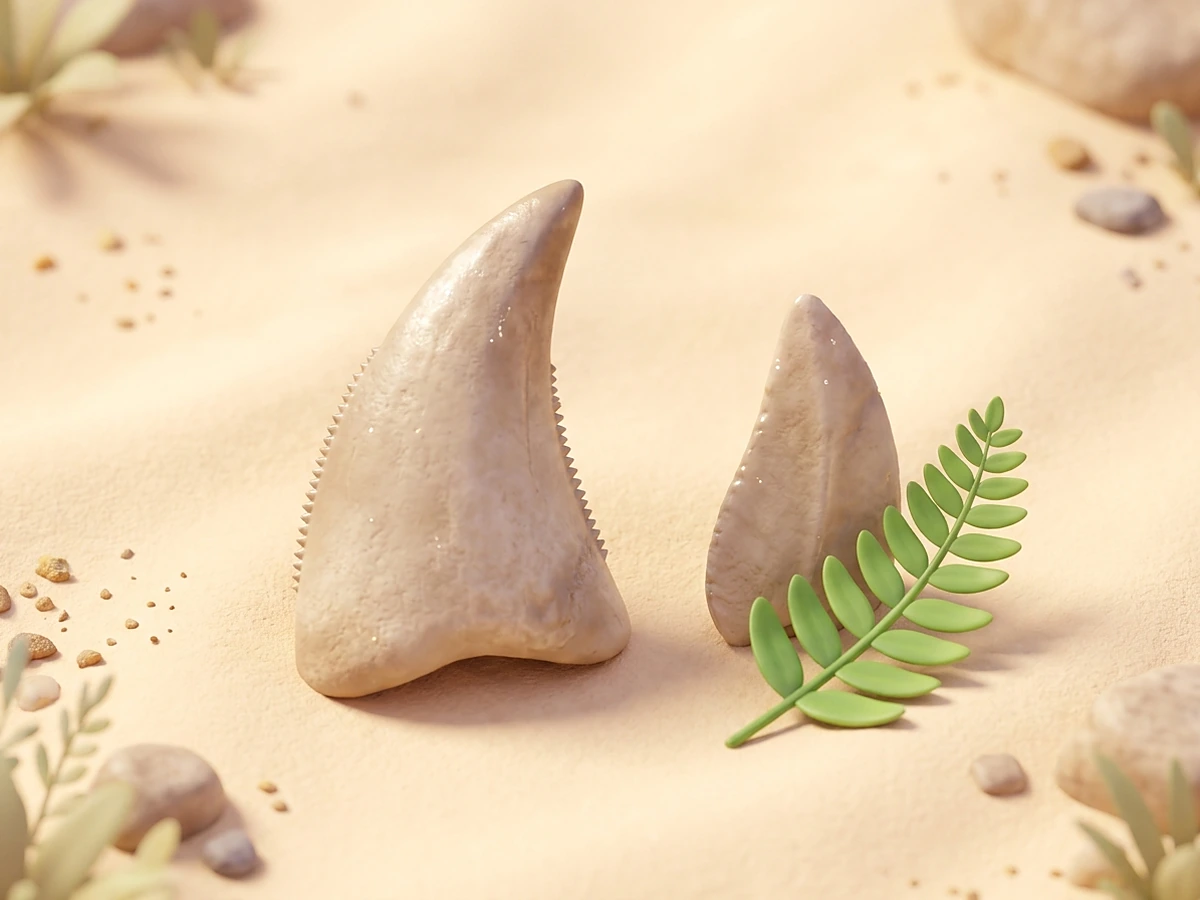
Teeth tell us what a dinosaur ate
Meat-eating dinosaurs like Tyrannosaurus had sharp, curved teeth with edges like a saw. Many plant-eating dinosaurs had small, leaf-shaped teeth.
Why? A saw-like edge cuts meat, and leaf-shaped teeth snip and shred plants. It is the same with animals today. A cat's teeth are sharp, and a cow's back teeth are flat for grinding grass.
Try at home: Look at your teeth in a mirror. The front ones cut and the back ones grind. Which ones do you use to bite into an apple?
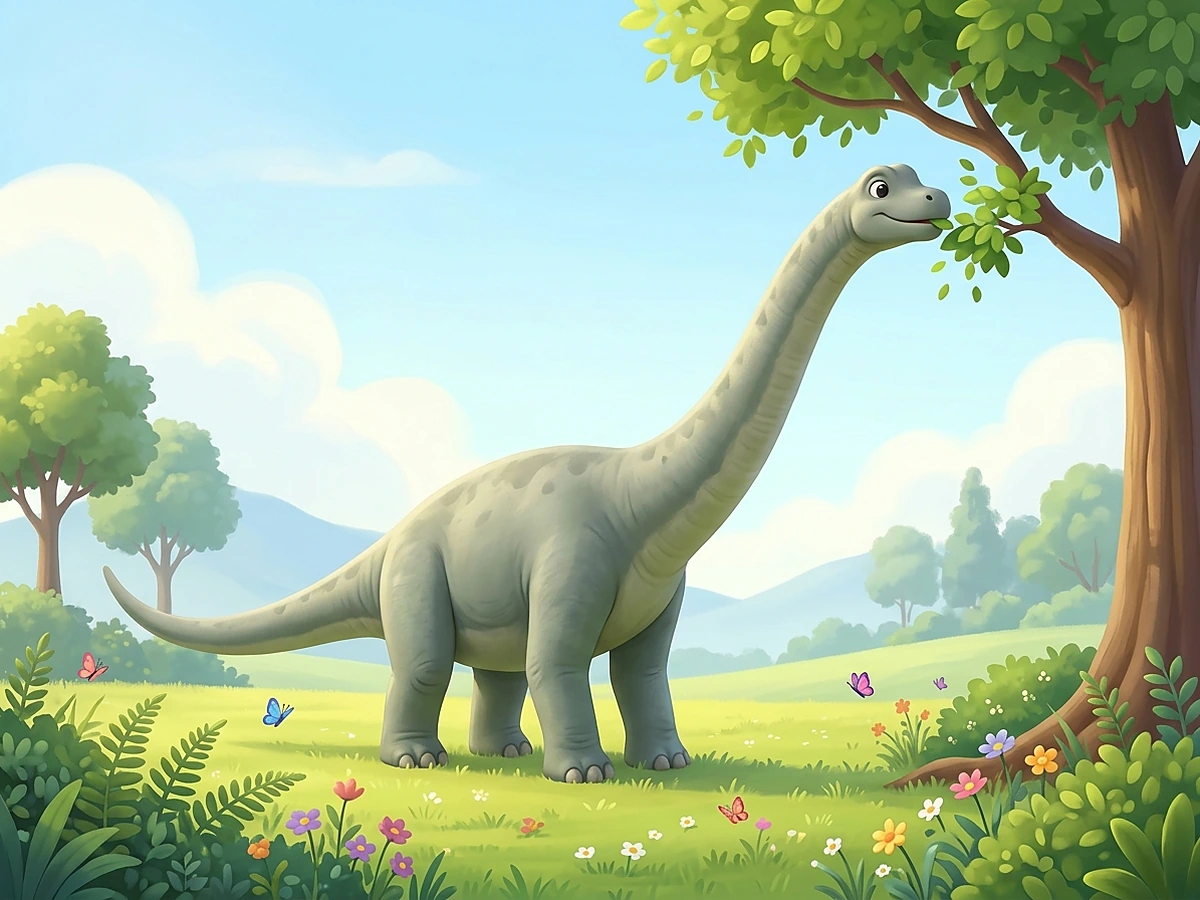
The biggest dinosaurs were long-necked plant eaters
The biggest animals that ever lived on land were long-necked, plant-eating dinosaurs. The largest were longer than two buses parked end to end.
Why? With their long necks, they could reach plants over a wide area without moving their huge bodies much. That way they did not waste energy.
Try at home: Stand still and, without moving your feet, touch everything your arms can reach. Then imagine your arms were twice as long.
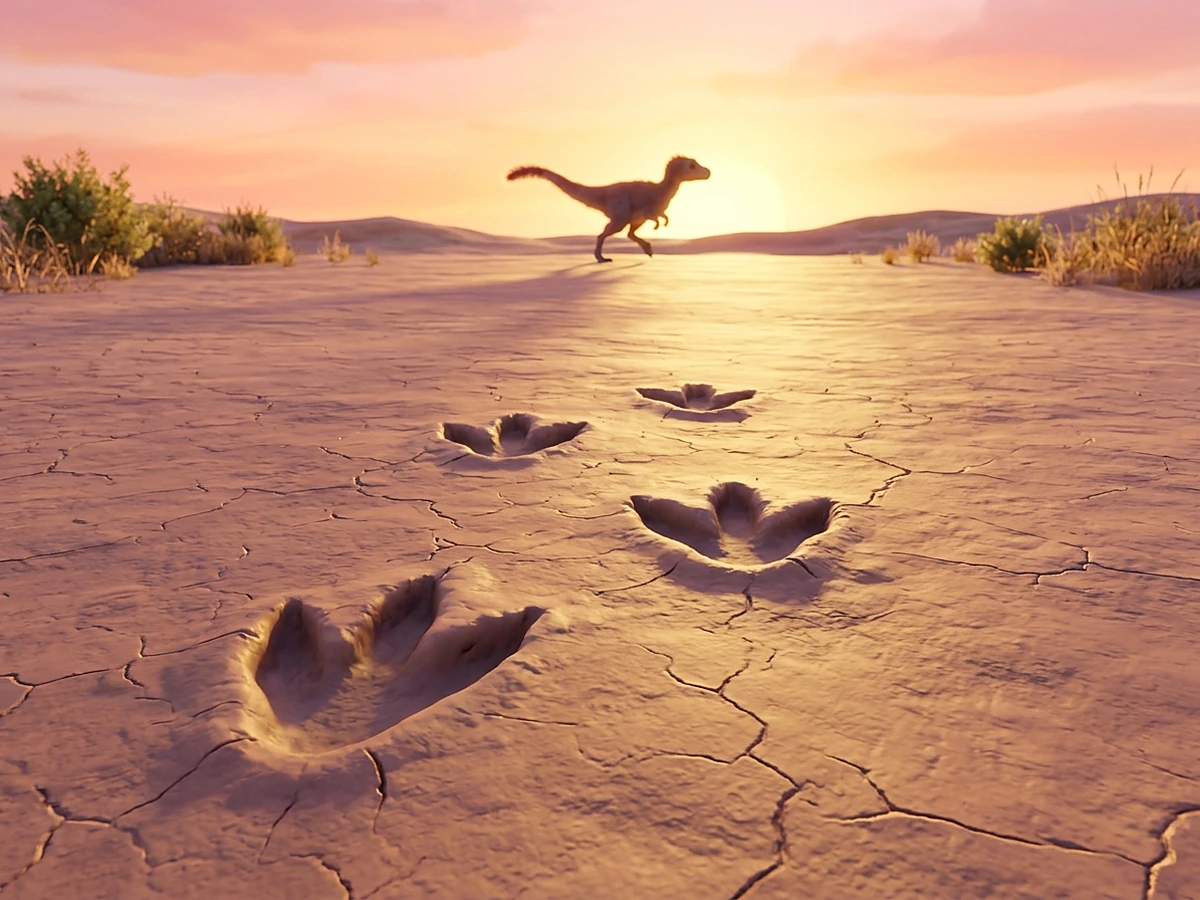
Footprints show how a dinosaur walked
Some dinosaur footprints in soft mud dried and turned to stone. They show if a dinosaur walked on two legs or four, and how fast it was going.
Why? The faster an animal goes, the longer its steps are. Scientists measure the size of the prints and the space between them to work out how fast a dinosaur was going.
Try at home: On sand or soft earth outdoors, walk first and then run. When are your prints further apart?
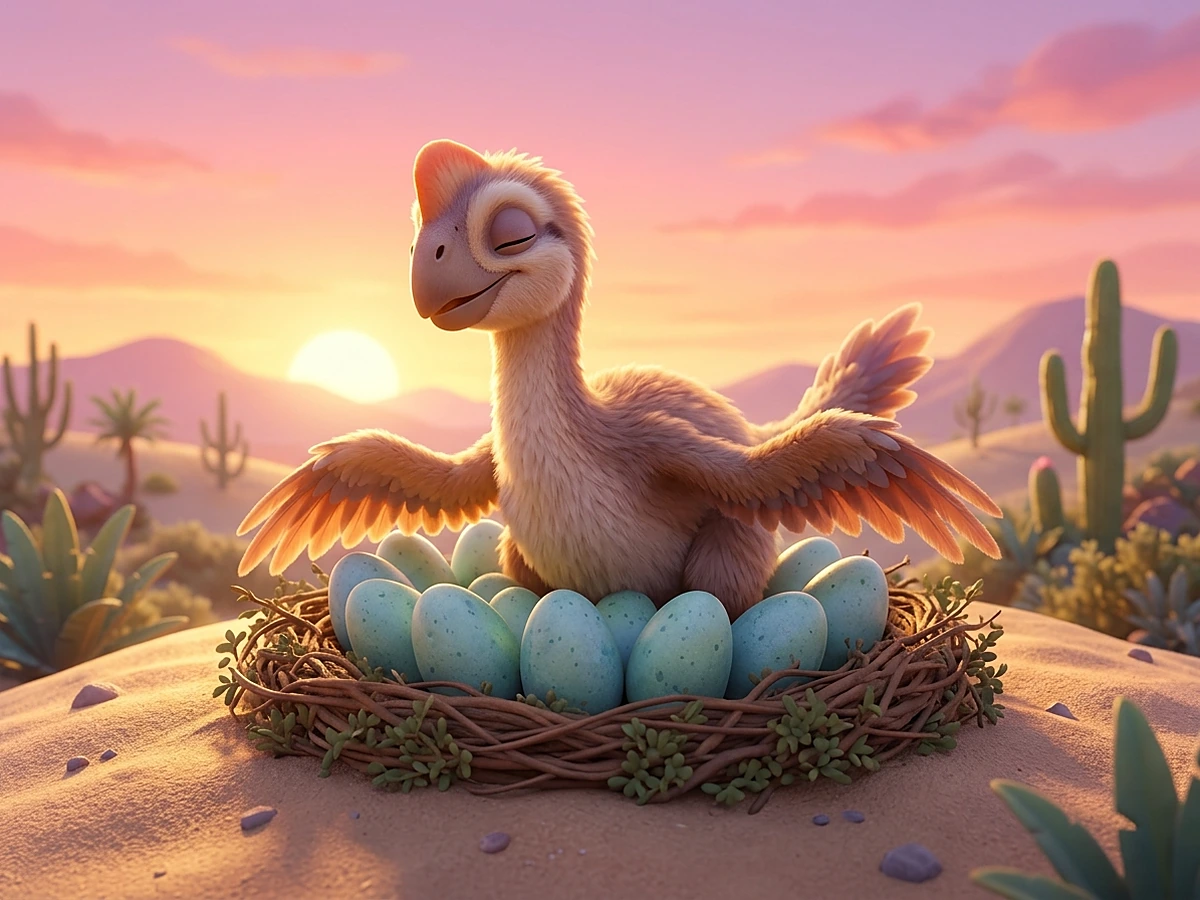
The “egg thief” was really keeping its eggs safe
As far as we know, all dinosaurs hatched from eggs. In 1924, a dinosaur found next to some eggs was named “egg thief”. About 70 years later, a dinosaur from the same family was found sitting on its nest, like a bird.
Why? An animal sitting on its eggs is not stealing them but keeping them warm and safe. When the new fossil was found, scientists changed their minds. New evidence can correct an old idea.
Try at home: Rub your hands together until they are warm, then cup them around a ball. Can you feel your warmth passing to it? Birds keep their eggs warm with their bodies in the same way.
From dinosaurs to today
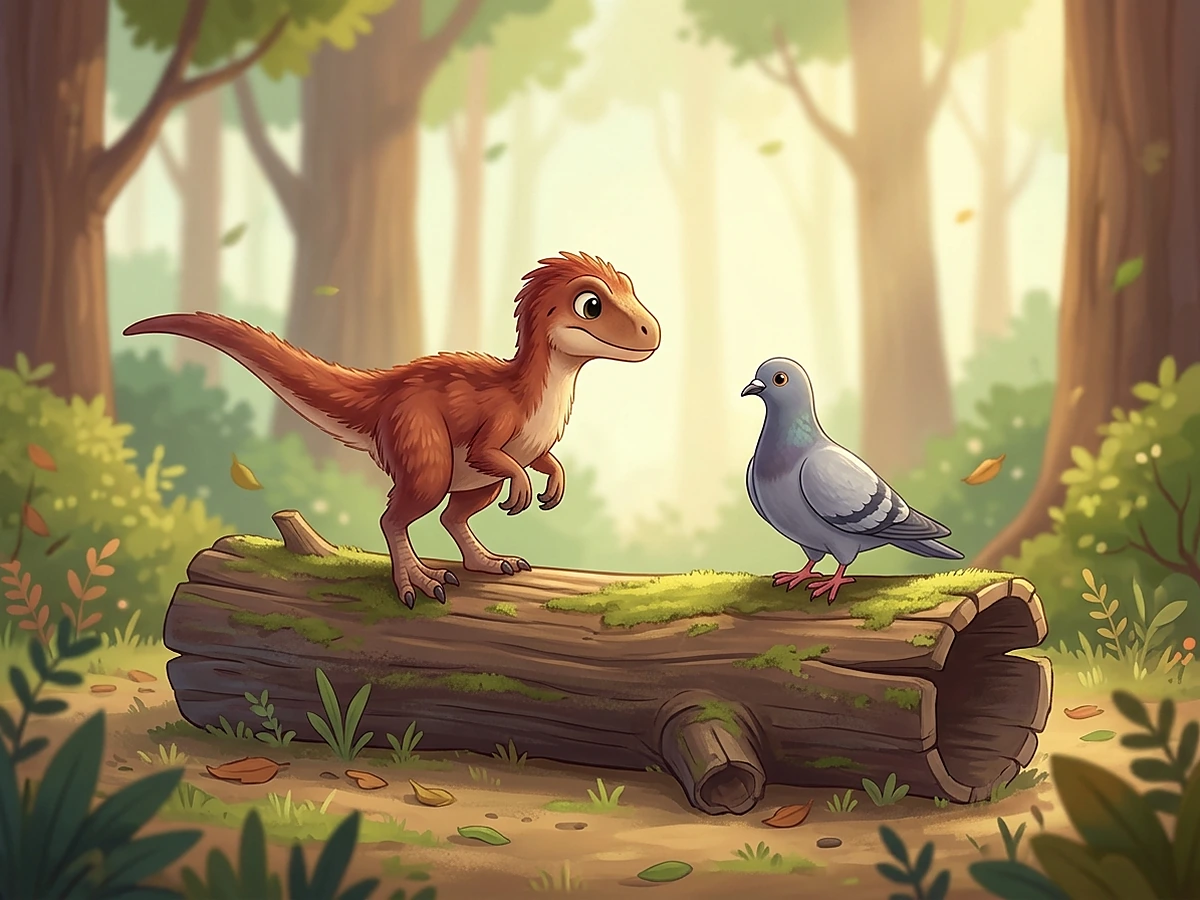
Birds are the dinosaurs' living descendants
Scientists have found that birds come from small, feathered dinosaurs. So the sparrow outside your window is a dinosaur's descendant too.
Why? Birds and these dinosaurs share many body parts. Both have feathers, hollow bones, a wishbone and three toes pointing forward.
Try at home: Look closely at a pigeon's or a hen's foot. Do three toes point forward? Many dinosaur footprints look like that.
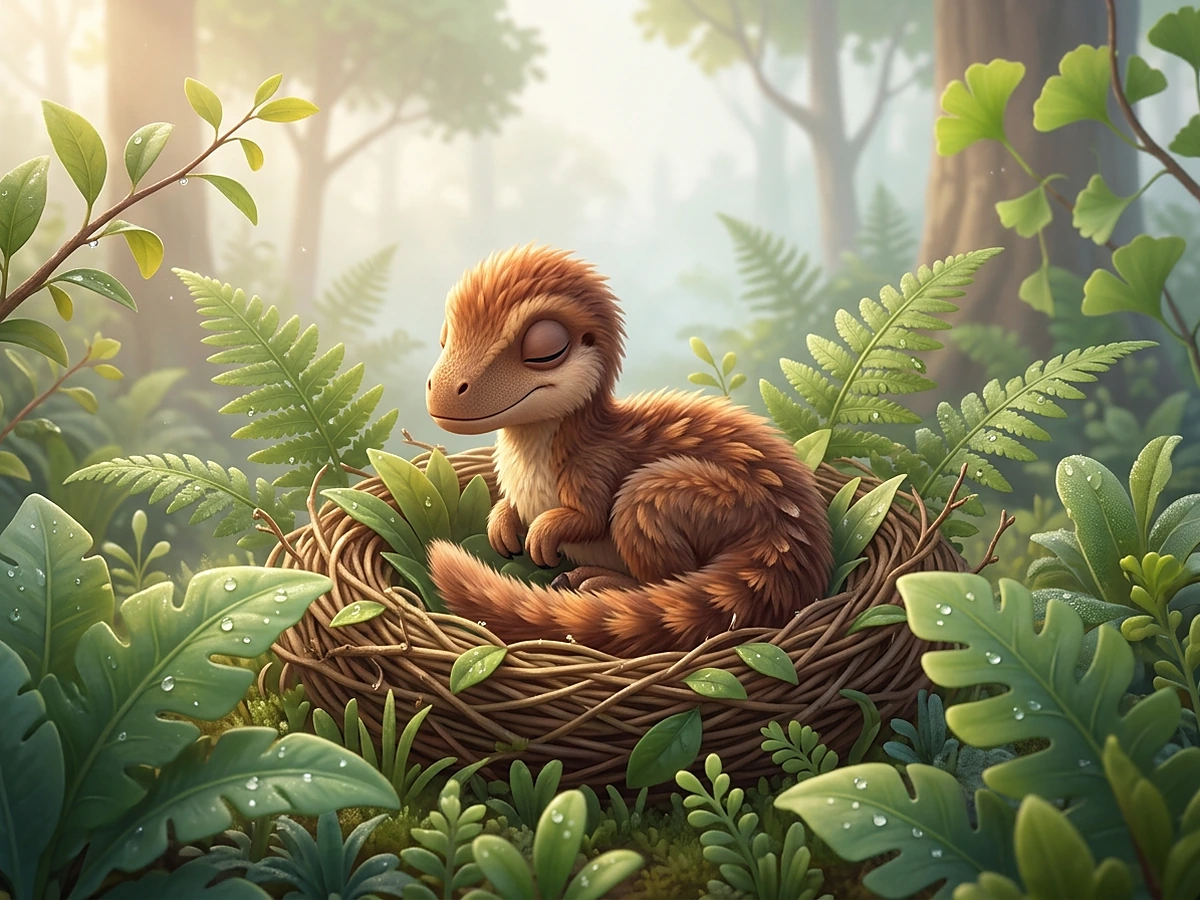
Many dinosaurs had feathers
In 1996, a fossil of a feathered dinosaur was found in China. Since then, many more feathered dinosaurs have been found. Most of them could not fly.
Why? Many scientists think the first feathers were not for flying. They most likely kept the body warm. Feathers trap air between them, and the trapped air holds in body heat.
Try at home: Press your hand into a feather pillow, then let go. Does the pillow puff back up? The air between the feathers is what keeps you warm.
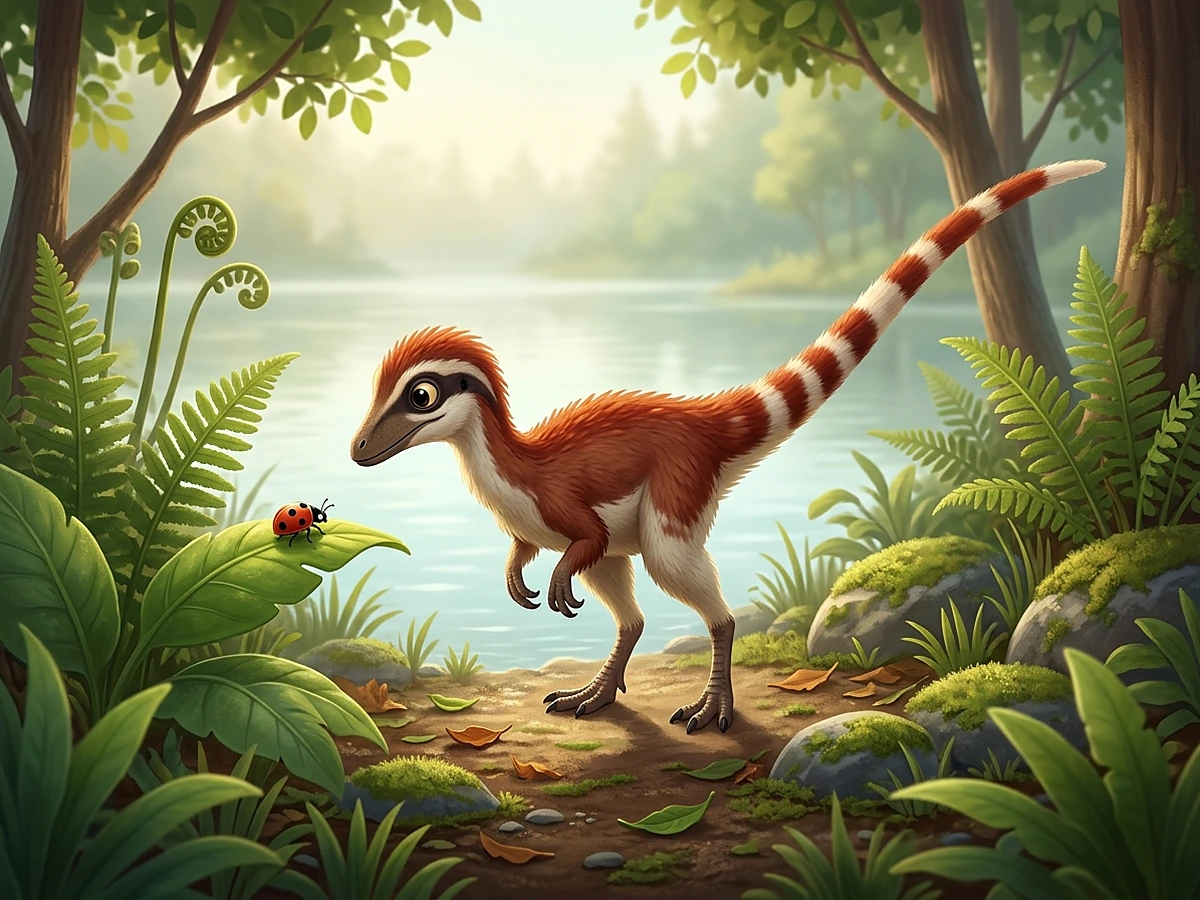
We know the colours of a few dinosaurs
For most dinosaurs, nobody knows their colours. But scientists found tiny colour grains in the feather fossils of a few dinosaurs. One of them had a tail striped reddish brown and white.
Why? The shape of the grains shows the colour. Long, sausage-shaped grains make black or grey, and round ones make reddish brown. Scientists know this from the feathers of birds today.
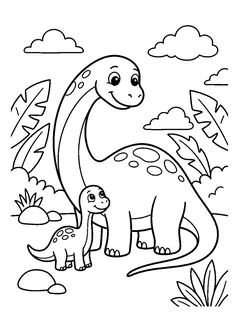
Try at home: Colour the dinosaur family on the colouring page. Try reddish brown and white stripes on one tail.

A huge asteroid ended the age of dinosaurs
66 million years ago, a huge asteroid hit the coast of what is now Mexico. Dust and smoke filled the sky and blocked the sunlight for a long time, so plants could not grow well. All the dinosaurs died out except some birds.
Why? In many places around the world, a thin layer of clay from that time has much more iridium than usual. Iridium is a metal that is rare in the rocks on Earth's surface but more common in asteroids. That is how scientists worked out that an asteroid had hit.
Try at home: With a grown-up, spread flour on a tray and drop a small marble on it from above. Look at the hole it makes and the flour that sprays out.
Dig
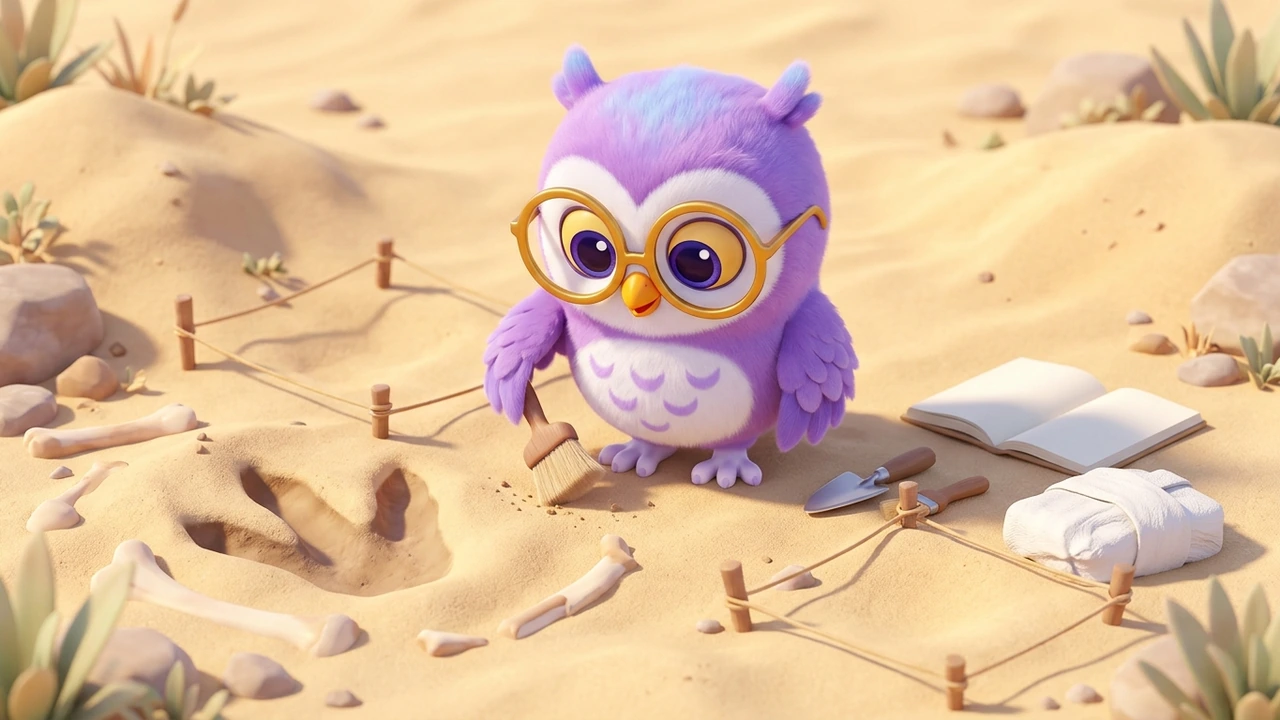
Hece is on a dig. Brush the sand away slowly to find the fossil underneath. Then choose what it tells us.
Dinosaurs quiz
Ten questions, one at a time. A wrong answer is not a loss: try again, and a hint is there.
Games and fact pages
Books
Colouring pages
For grown-ups
- The aim of this world: to notice how scientists read a past nobody saw, from clues such as fossils, rock layers and footprints, and that new evidence can change an idea. It prepares for the fossils topic in primary science (grade 3 in the new Maarif programme; grade 4 in the older programme still used by grade 4 classes).
- Ask: how could we find out what a dinosaur ate without ever seeing one? Count the clues together: teeth, footprints, eggs.
- Ask after the quiz: like the scientists who studied the “egg thief”, have you ever changed your mind after learning something new?
- Do it together: watch a bird outside. Look at its feet, the way it walks and its feathers, and talk about what it shares with the dinosaurs on the cards.
- If the asteroid worries your child: it happened 66 million years ago. NASA tracks the asteroids that come near Earth, and no known asteroid larger than 140 metres has a significant chance of hitting Earth in the next 100 years.
- Sources are listed in this section. Game progress is saved only on this device.
Sources
- A fossil is a piece or trace of ancient life kept in rock: Natural History Museum (London), “How are dinosaur fossils formed?”
- Rock layers are like the pages of a book: U.S. Geological Survey, “Geologic Time: Relative Time Scale”; U.S. Geological Survey, “Fossils, Rocks, and Time: Rocks and Layers”
- A palaeontologist digs slowly: Sues (2019), Smithsonian Magazine, “How Do Paleontologists Find Fossils?”; Natural History Museum (London), “How to find dinosaur fossils”
- Teeth tell us what a dinosaur ate: Natural History Museum (London), “Beyond Jurassic World: what we really know about dinosaurs and how”
- The biggest dinosaurs were long-necked plant eaters: Sander et al. (2011), Biological Reviews, “Biology of the sauropod dinosaurs: the evolution of gigantism”; Natural History Museum (London), “What was the biggest dinosaur?”
- Footprints show how a dinosaur walked: Alexander (1976), Nature, “Estimates of speeds of dinosaurs”
- The “egg thief” was really keeping its eggs safe: Norell et al. (1995), Nature, “A nesting dinosaur”; American Museum of Natural History, OLogy, “Oviraptor philoceratops”
- Birds are the dinosaurs' living descendants: Brusatte, O'Connor and Jarvis (2015), Current Biology, “The origin and diversification of birds”
- Many dinosaurs had feathers: Chen, Dong and Zhen (1998), Nature, “An exceptionally well-preserved theropod dinosaur from the Yixian Formation of China”; Benton, Dhouailly, Jiang and McNamara (2019), Trends in Ecology & Evolution, “The early origin of feathers”
- We know the colours of a few dinosaurs: Zhang et al. (2010), Nature, “Fossilized melanosomes and the colour of Cretaceous dinosaurs and birds”
- A huge asteroid ended the age of dinosaurs: Alvarez et al. (1980), Science, “Extraterrestrial cause for the Cretaceous-Tertiary extinction”; Schulte et al. (2010), Science, “The Chicxulub asteroid impact and mass extinction at the Cretaceous-Paleogene boundary”
- Hublin et al. (2017), Nature, “New fossils from Jebel Irhoud, Morocco and the pan-African origin of Homo sapiens”
- Berv and Field (2018), Systematic Biology, “Genomic signature of an avian Lilliput effect across the K-Pg extinction”